Sunday, March 6, 2011

Karnival ta Malta

We were fortunate enough to be in Malta for Carnival (il-Karnival ta' Malta in Maltese). Carnival is a period of festivities before Lent and is most common among Roman Catholic communities. According to one of the people we talked with here, the Carnival festivities in Malta are the 5th largest in the world. Pretty impressive for such a small country. During Carnival, there are parades with colorful floats, dance events, various booths set up and many people dressed in costume.


Valletta (the capital of Malta) has one of the bigger carnival festivals in Malta so we made our way there on the old buses. Upon arrival near Valletta, we noticed lots of very brightly colored floats by the entrance to the city in preparation for the big parade that evening. Our group wandered around the town some, taking in all the sites and interesting costumes and stopped at a restaurant for an early dinner. We decided to try some traditional Maltese food including rabbit. I only tried a small piece, but we all agreed that it was not that different tasting than other meats like turkey or pork. It was interesting to see the whole chest cavity and some of the internal organs though.


After our meal, we watched the parade briefly as it began to pass by. All of the floats (and a number of the costumes as well) were bright neon colors and it was interesting to see, although definitely not what I was expecting initially.


Our group split up and continued exploring around Valletta. We talked for a while with several guys who had an adorable puppy. They were very friendly and offered a diverse perspective -- one was from France, another from Spain, another from England, and the puppy was from Malta. We took turns holding the puppy and listened to their stories and advice about things to see and places to go.


We finished our evening adventures with some more exploration of Valletta including sitting in on part of a Catholic church service, trying some Maltese desserts at a small cafe that was recommended to us, and more observation of the Carnival parade. Overall, a very full evening and an interesting insight into Maltese culture.

Mmm... Rabbit Season!


After hearing of some of the local dishes, some of the group were very excited to try one in particular: Rabbit. Figuring this is an opportunity that very few Americans will have in their lifetime Jeff, Tyler, Jane, and I all decided to try it while in Valletta yesterday for lunch. Not knowing what to really expect, we were served almost an entire rabbit cut into several pieces (including the lungs, heart, and liver) in a thick, brown sauce. Jeff immediately dug in with both hands and cleaned the bones like he hadn't eaten in months (and might have eaten a couple of the bones as well). Tyler joined suit. I held out for a little while, but my knife and fork did not handle the small frame of the rabbit very well, so I caved in and started using my fingers for eating like my companions had. At first the rabbit seemed rather meatless, but once passed the ribs I realized my mistake. It took a few bites for me figure out the taste, but I eventually got it. The rabbit actually tasted a lot like pork to me. It was a very tasty lunch, and although I was not a fan of the organs I would definitely try it again.

I once heard of an ancient legend that long ago Timmy Gambin smuggled rabbits to Malta in his beard in order to feed the island.

Saturday, March 5, 2011

Mdina, Round 1

Our site for Wednesday was within the walled city of Mdina (http://en.wikipedia.org/wiki/Mdina). The first cistern was located in a restaurant called Bacchus, which was not open for the day yet.
This caused our time for exploration to be slightly shortened, as we had to be out before they opened. After arriving, during setup and some of the time spent in the cistern, about half of the team was able to wander around the restaurant with the owner getting a bit of a history lesson. There was much history to discuss since the room was built between 1657 and 1660! Since it was before business hours, many people transporting supplies for Bacchus were filtering in and out of the front entrance where we were located. Many stopped momentarily to see what we were doing, and were very interested in our sonar maps of the underside of the restaurant as well as the images we were receiving from the VideoRay.


In an effort to rotate drivers during different sites, Christina watched closely as I drove the VideoRay through this site so she could become familiar with the logging process and hopefully gather useful data. After gathering data for awhile, the ToughBook lost communication with the control box. After a quick bit of unsuccessful troubleshooting, it was about time to leave, so we headed to the next location.

The next spot was The Mdina Experience, right down the street. There was very limited space here, and it was during normal business hours.


There was actually a tour group passing right through our site when we arrived. They watched as we brought in and setup all of our equipment, but weren't interested enough to ask any questions. We switched to the Samsung backup since we thought the problem was with the ToughBook and did not have time to continue troubleshooting it on-site. Slightly different connections had to be made when using the Samsung, since it lacked a serial port, but everything worked out and we got the VideoRay through the small entrance and into the water.

Space was limited, so team members not directly involved couldn't really be present, so exploration presented itself again!

Another restaurant was our final location of the day. The cistern here was located in the basement. We had to walk through the restaurant which caused for some further stares of the other patrons. There was an extremely narrow passageway leading down to the site, and our equipment had to make it carefully down the long staircase. To add a bit to difficulty, the passageway was lined with wine bottles so there was little room for error. Luckily, Tyler and I made it all the way down successfully.

After making it downstairs and setting up, the data collection process began. Christina drove for for the first time on this site, and did an awesome job grabbing sonar scans and video for the cistern we were on top of. This cistern was composed of a large circular room and a narrow hallway that didn't lead to anything. We ended our day here, and loved the view off the balcony behind the restaurant!

Pressure Problems

Calibrating the ROV depth sensor has been a continuous event throughout our trip. Our excursion to the Mdina cisterns began with an investigation of the local gas station air compressors. Before getting there we were discussing all the different units of pressure that we might run into to preempt converting units if we had limited access to the air compressors. It turns out the common units were lbf/in^2 and Bar. The first gas station had a free air compressor to use but the pressure was no more than ~20 psi but there was no pressure gage to know for sure so we moved on. We found another gas station nearby with an adequate air compressor and the gas attendant was very excited to help us when he saw our robot. The pressure from the air compressor was not high enough and after briefly explaining the problem to the gas attendant he began brainstorming with us on how to solve the problem given the limited equipment we had to work with. After clarifying the problem, he left and came back shortly with a small plastic cap and he began using a knife to take out some of the plastic so it would fit better on the air compressor nozzle. Billy and I fastened the make-shift pressure adapter onto the nozzle and we were able to get the correct pressure to calibrate the ROV. We never knew how exciting it would be to calibrate the ROV (again) and gain so much knowledge about engineering and culture in Malta. Learn by doing at its best!


Chuck Norris jokes are good but Timmy jokes are better simply because Timmy is the subject.

Friday, March 4, 2011

The Most Interesting Man in the World


Timmy Gambin - "The Most Interesting Man in the World"


From the start we all loved Timmy. Tyler said "from the moment I laid eyes on him I knew he was amazing." We have all continued to be amazed by this incredible man. From his seemingly endless knowledge to his striking resemblance to "the most interesting man in the world" in the Dos Equis commercials often seen in CA, Timmy Gambin may actually BE the most interesting man in the world.


Today we went to the hardware store a few blocks up from the street we are staying on, Howard's Hardware Shop looking for more plug converters (we have been battling over the handful we have - we are trying to avoid resorting to violence), an extension cord (sometimes 20 meters isn't enough), a surge protector (we blew up the one we brought from the US - our power learning curve has been slow), a large trashcan (to help test the depth sensors for the ROV), a hair dryer (apparently it is more expensive to buy a transformer than a new hairdryer), and an exacto knife (to avoid toxic fumes from melting apoxy).

It was at this hardware store we discovered Timmy's expansive amazingness - the two men in the hardware store both knew him well. An even more amazing discovery: one of the men in the hardware store was the original author of the first paper published about the cave we will be exploring next week. Timmy really must be incredible to have these connections everywhere we go.

It didn't take long for the complements to start:
"Timmy created Chuck Norris jokes for the attention to be takin off of him"
"Timmy doesn't need a bow-flex, so he gave it to Chuck Norris"
"Timmy touched me today and my spider bite was instantly healed - he is that amazing"
"Timmy doesn't need to do laundry - he just blows on his clothes and they are instantly sterile"
"Timmy doesn't need to trim his perfect beard because he efficiently re-directs the proteins to other parts of himself"
"Timmy knows everything"
"Timmy didn't just write down history - he IS history"


As you can see, we are very impressed with our archeological and spiritual guide here in Malta. He has been wonderfully accommodating, providing guidance, history, and insight into the culture of Malta. We are looking forward to spending more time with him over the course of the next 3 weeks. We love you Timmy!

It’s the Small Things…

Still???

On the flight from Chicago to Frankfurt, we flew on a German airline: Lufthansa. This was a long eight hour expedition, so it was nice to have the two meals included on the flight. Behind me, Joseph was happily eating his chicken-rice-vegetable teriyaki-like dinner with his glass of water. When the steward walked by a second time, he asked me if I wanted another drink. I requested my orange juice, as usual. When the steward asked Joe, he replied, “Water please.” The steward responded, “Still?” Obviously confused why the steward was rudely wondering why he wanted more water, Joe asked, “What?” “You want your water still?” By this time, we understood that the steward was asking if Joe wanted still water, as opposed to sparkling water. We mentioned to the steward the reasoning for our confusion—that we thought he was asking if he wanted water again, since we are never asked to clarify our choice of water in the United States as either sparkling or still. The steward realized the confusion and laughed with us at the different contexts of the word ‘still.’

On the topic of water…

Having been unprepared for a long day away from our apartment in Mdina, we realized we were thirsty and had depleted our repeatedly refilled plastic and metal water containers. I went on a water hunt in the ‘Walled City,’ expecting any institution to gladly fill me up. I asked a woman handing out fliers if she knew where a water fountain was, and she pointed down an alley, but as she did so, she continued to explain (in Maltese) about the flier she just gave me. Deciding that she assumed I was interested in what was on her flier, I thanked her for the information and didn’t go down the alley that I wished had a water fountain. I asked a woman in front of a restaurant for a drinking fountain, but she clearly didn’t understand me, so I pointed to my empty water bottle. She said, “Oh yes, I can throw that away for you.” After clarifying my question, she said water had to be purchased. I went into a little cafeteria and asked for a water refill. An employee directed me to the bathroom, and I filled up. I returned with Andy and a handful of empty water bottles. Following our fill-up in the same bathroom, a lady stopped us: “You can’t just fill up like that and go! You need to leave these bottles here and buy water here.” I explained that I was directed to the bathroom for water previously and didn’t know that we couldn’t fill up water there. “No, I think you knew. You need to leave these here and buy this water. This is a private place; you need to go to a public facility for free water.” We dumped our bottles and left outside the Walled City to a public bathroom, where a gentleman went into the back of the bathroom to fill our bottles in a janitor sink. I later left a tip for him—a few of the bathrooms I ran into worked this way, where a janitor cleaned and monitored the bathroom all day (and some cleaned after each use) and asked for tips. The moral of this long story about water? Water is not expected to be provided complimentary in public places, or even in a private restaurant/café/shop. What did we learn? Fill up extra bottles with Britta filtered water before we leave.

Why the difference in water accessibility? Perhaps water isn’t considered a free resource as it is in the US. Perhaps its availability is less here in Malta. Maybe it’s just not a standard adopted here, and the US has placed bathrooms and water fountains in the same category as handicap accessibility and fire safety. We just made it a necessity, where here in Malta, it’s a privilege. We might consider the lack of water as an inconvenience. A Maltese person might consider our abundance of free water wasteful. Is one way right? No. Just different.

Early Morning Groceries

Last night was the first time in a while that I went to bed at a reasonable hour (9pm). Consequently, I was bright and bushy much earlier than the previous days. Although today it was less bright and more cold and blustery. With an appetite for pancakes, and no butter or syrup in the apartment, I went off on my own about 7am. I found a tiny grocery shop less than two blocks away off the busy and narrow Triq Guze’ Howard street. There was a bustle of about five people gathering their daily groceries of bread, butter, milk, etc. I found my _humble_ container of syrup. It took some time finding it, and only recognized the word “maple,” but decided there wasn’t much else with maple flavoring. Butter, ketchup, soy milk, syrup, and jelly, all humble sizes and pricing about ten euros. I filled my little re-useable fabric grocery bag with my daily groceries in the early morning, anticipating my return the next morning like a native of Malta would. Hopefully within the next week, I will have the map of the area down in my head like a native.

A Rocky Beginning

We've had an exciting last few days exploring our sites, but we've been having some technical issues along the way. First, upon opening one of the control boxes we discovered that one of the LCD screens was badly damaged. Attempts to use it were unfruitful. Fortunately, the other display is still intact, and it does not seem like we'll be needing either soon.

At our first location, Gomerino Palace, we had some good data collection which was accompanied by some minor mishaps. When trying to use a power strip with US sockets and a socket adapter during our a we quickly realized that a US power strip meant for 120 volt sockets will not handle 240 volt sockets. The second could not be explored since the water level was not high enough. Our third cistern happened to be surrounded by a lot plants, so there were a lot of roots hanging down into the cistern. After a few minutes of driving the ROV around many small roots got stuck in the top propeller. Someone noticed quickly and we were able to get the ROV out and clear the roots off and continue.

The second area we visited was the city of Mdina, former capital of Malta known as the Silent City. Our first site was the Bacchus restaurant which was built in the walls of the city. Data collection went relatively smoothly at this location, with the exception that this was the beginning of a recurring problem with the depth sensor not reading correctly. We also were not able to get HD footage since the battery in our camera died after about 3 minutes. There was a minor hiccup with the USB ports on our toughbook, but restarting seemed to remedy that for the time being. This didn't affect our sonar measurements since it was connected through the serial ports rather than USB. The USB issues continued at our next two sites, the Mdina Experience and a third restaurant, so we used one of our Samsung laptops instead of the toughbook. There were a few communication issues between our laptop and the ROV, but restarting both the laptop and the control box for the ROV resolved these problems.

Before our second trip to Mdina we decided to recalibrate our depth sensors at a local gas station, which seemed to work at the time, but did not once we got on site at the St. Paul's Cathedral Museum, so we switched to static mapping. This is just a fancy way of saying that our robot is sitting still while taking sonar measurements. Using this technique we get 2D maps instead of 3D maps since we do not move up and down to get sonar readings at different depths. Our HD camera was fully charged this time and got some good video. Other than the depth sensor, the only major issue we had at the Cathedral and the Cathedral Museum was the fact that some of the waterways were more shallow than we had hoped for, so we weren't able to explore as easily into some areas as we had hoped for. We did get some interesting readings as we thought two of the waterways we were looking at would be connected directly, but actually had tunnels that went in different directions. Overall, we've had a rocky start, both trying to recover from jet lag and making sure our robot is working well enough to get data, but we still have a lot to show for it.

Late Night Repairs

When we arrived in Malta on Monday, the LCD in one of the control boxes for the VideoRay was broken. (It was working before we left). Since we have two control boxes, we managed to use the working control box with the VideoRay to continue exploring wells and cisterns. On Wednesday night, it was time to start analyzing the data to verify whether or not it was valid. Only after about 15 minutes, it became apparent through a sanity check that most of the depth measurements were invalid. (The invalid data sets had a depth of -17 meters). After discussing this with Joe and Chris, Joe emailed VideoRay about the problem. They responded within the hour suggesting we disassemble the control box and analyze it for loose connection or faulty components if we were brave enough.

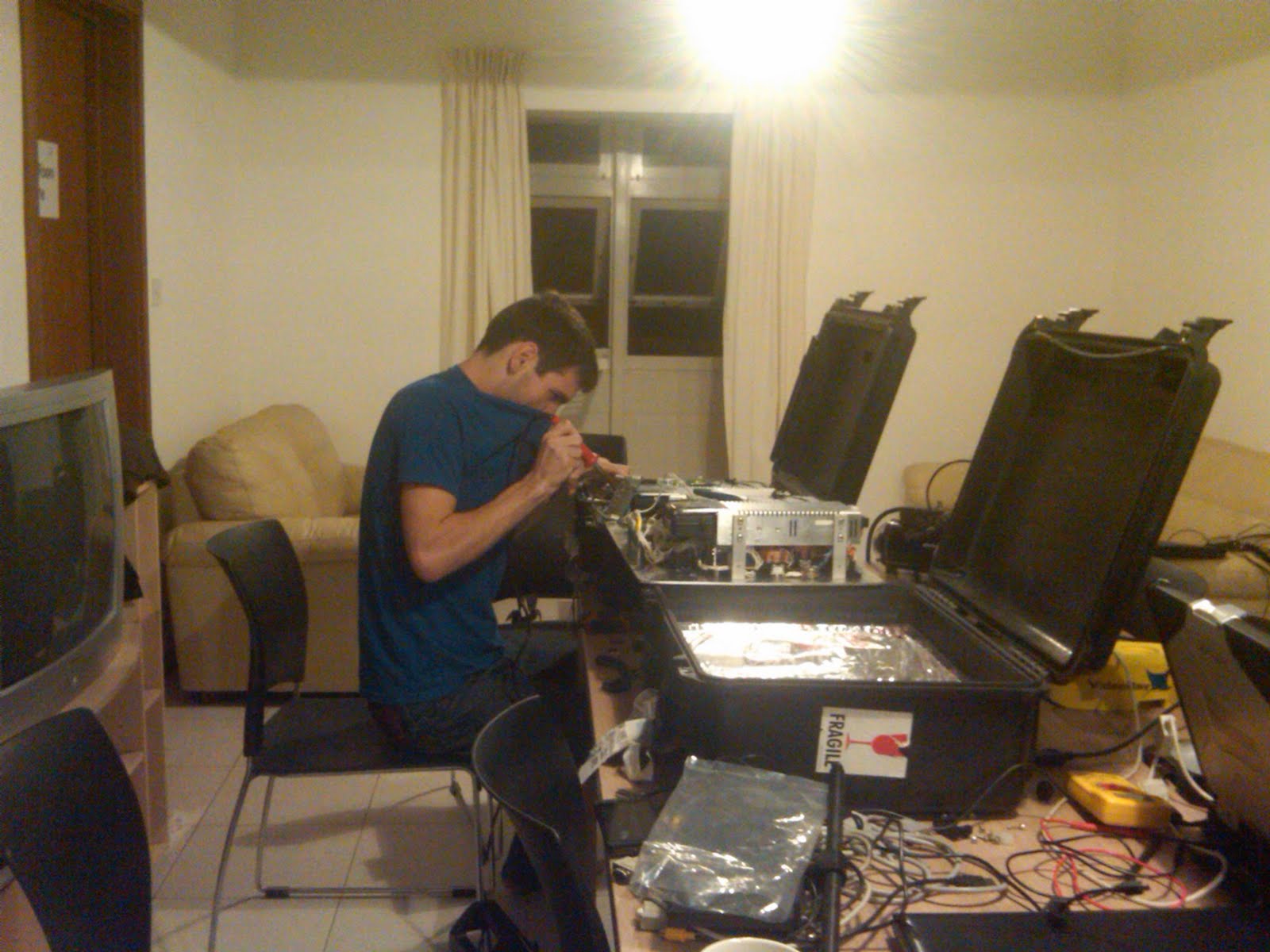
Immediately, I brought out the tools and began tearing it down. During this breakdown process, Joe, Jane, and I began brainstorming about what the problem could possibly be. I decided to start with fixing the LCD screen on the broken control box in order to check if that control box was recording a depth of -17 meters. I began switching out components from the broken control box with the equivalent components in the working control box to consolidate the problem. After ruling out the LCD screen itself and the removable Atmel microcontroller, I melted off the epoxy on the PCB connectors of the LCD control board with a soldering iron and found that switching the LCD control board out with the other control boxes LCD control board solved the problem. When switching these boards, both of the control boxes began to function properly (as far as the LCD screen goes). After discussing this with Joe and Jane, we concluded that the problem must have been from the epoxied connectors since the both of the LCD screens worked after switching them out.


It was about 5am, Malta time, when we reassembled the boxes and calibrated the compasses for the next day. We then logged data using both of the control boxes separately with the VideoRay out of water and found that the depth reading was about 1 meter. We decided this value was better than -17 meters and we only needed to calibrate the depth sensor, which could be done in the morning. This was about the time we called it a night.

Wednesday, March 2, 2011

Taste of Maltese Culture

We had our first set of cistern explorations at Gomerino Palace on Tuesday. While waiting to get into the area though, we got a chance to walk down the road and explore a little. In addition to the beautiful landscape and lots of old rock walls and structures, we met an elderly Maltese man who invited us into his garden to show us the statue of St. Paul we had seen from outside earlier.


Beautiful Maltese countryside. There were walls like this all over

Lots of beautiful flowers in bloom and no shortage of interesting buildings.

Shrine/statue of St. Paul in the Maltese persons garden. He saw some of us looking over the low, stone fence and he invited us into his garden to get a better look. Most of the group went to Gomerino to go look at the cisterns as we had just got access to the site, but Brig and I stayed behind briefly to see what the guy had to share.

Side of the shrine. There is a small door (can be seen here somewhat) which leads inside to a small circular room

Inside there were several shelves of religious items set up. It was very interesting to see and brought to mind the statistics we had learned about the large religious presence in Malta.

Talking to the Maltese man. He was very nice but spoke next to no Engligh (only Maltese). It made communication a little hard but with some hand gestures and a charades-like guessing of meanings, we were able to understand the general idea. It was great to meet some of the locals already and it was encouraging to be treated so nicely by someone who was a complete stranger not long before.

Tuesday, March 1, 2011

A Troublesome Start

Unfortunately, our first technical blog will start a bit dreary. After the hustle and bustle of our many flights, and the changing of connections with our luggage, damage was done to the ROV’s stand. The picture shown below illustrates the complete fracture of the stand in two areas, leaving the stand unstable and hardly strong enough to hold its own weight on dry land. Our second technical problem of the day was also a result of the long journey and the solution to this problem is yet to be solved. One of the control boxes for the ROV no longer shows a display reading any of the crucial coordinates such as compass direction, depth and time. Although these technical problems are certainly not a great way to start our research in Malta, we still maintained high spirits and worked to solve these problems before days end.

Before we could fix these issues we needed to calibrate the depth sensor on the ROV with an air gun to 50 psi. The ROV uses a pressure reading to determine an accurate depth measurement shown in the control box. The problem was we did not have an air gun but luckily Timmy’s close friend Erin was here to help. Erin was kind enough to pick up Joseph and I, along with the ROV, took us to his boat on a small island called Manoel to calibrate the depth sensor. The first obstacle came in the form of a 3 foot gap between the landing and the 1 ft wide ramp leading to the boat with the equipment needed to calibrate the ROV. What would normally be a simple stretch or a light jump became very difficult with a large 45 lb. box holding the cables to the ROV. I almost attempted the jump but realized that would not end well and convinced Erin to dangerously lean over the ramp and grab the box from me. With the first hurdle out of the way we proceeded to calibrate the depth sensor with an air compressor he had on board the boat. Erin did not have the proper fighting to pressurize the small hole in the ROV to 50 psi but with a little ingenuity and some quick thinking by Erin we were able to cut the air hose and create a seal around the pressure sensor. After a few failed attempts at calibrating the pressure sensor, Joe and I timed the air gun to get the pressure coming from the gun to be 50 psi right when Joe pressed the calibrate button, ensuring an accurate calibration. Our test with Erin’s underwater sonar matched the readings we were seeing on the control box ensuring our make-shift calibration was successful. After all the troubles of getting the correct pressure dialed-in, the depth calibration was finally correct but there was still the ROV stand and the control box to fix.

Although our ROV stand was broken, our backup (nonfunctional) ROV became very useful for spare parts and the stability was renewed again when we switched the two stands. We were unable to fix the control box for the time being but we believe it may just be a loose connection and we will investigate this problem as soon as we are able to.


Picture: The ROV's fractured stand (some of us may refer to them as the "legs" of the robot)
Locations of Site Visitors